What causes swirl marks on car paint, and what removes them
Swirl marks are fine scratches in the clear coat, put there by the wash itself. What causes them, what genuinely removes them, and what only hides them.
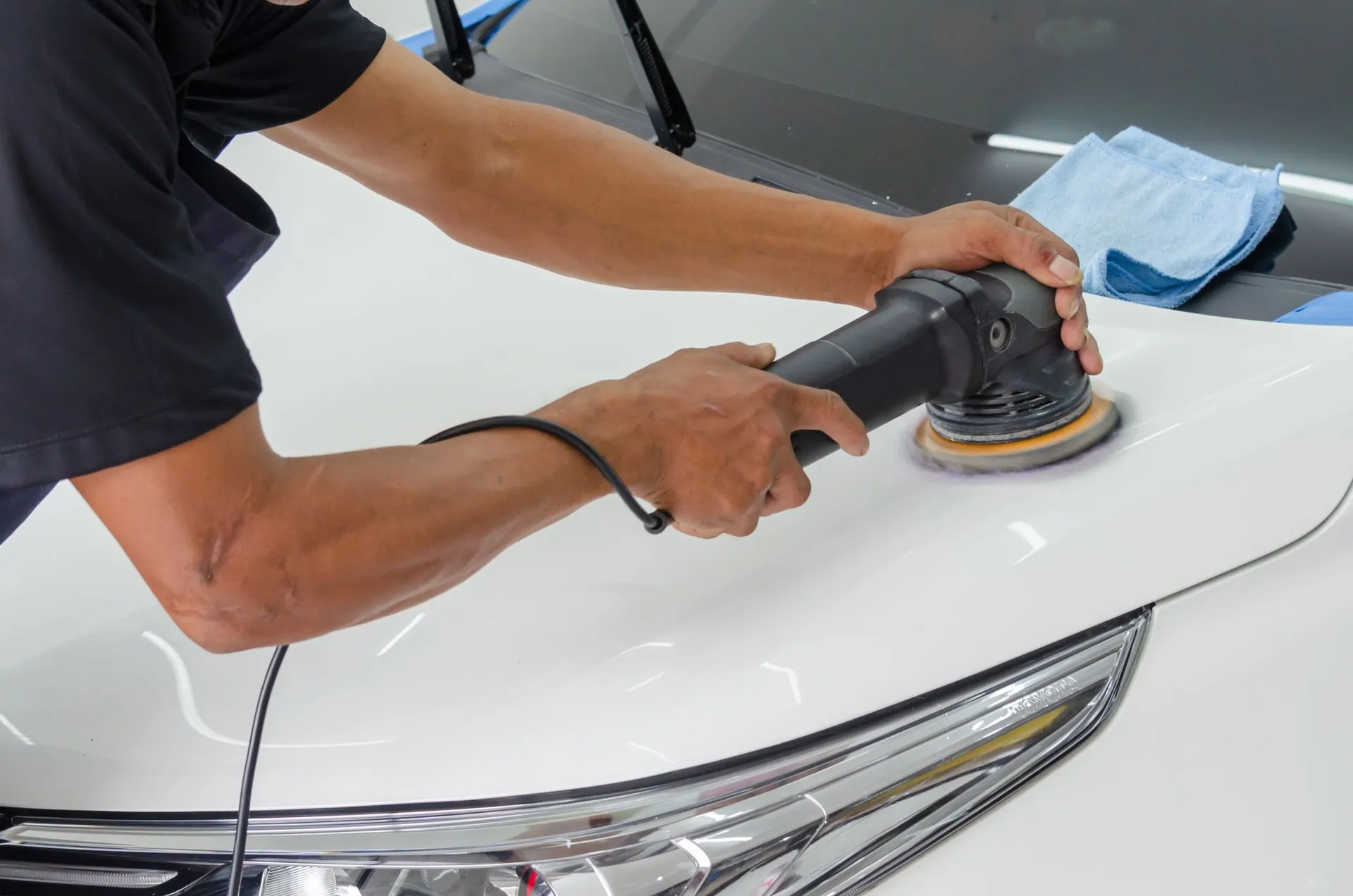
Park a dark car in open sun and look down the bonnet from a low angle. Around the bright reflection of the sun you will see a faint web of fine curved scratches, thousands of them. Move your head and the web moves with you. Those are swirl marks, and almost every one of them was put there by somebody cleaning the car.
What a swirl mark actually is
Paint on a modern car is built in layers: primer, then the colour, then a clear coat over the top. The clear coat is the layer you touch, the layer that holds the gloss and the layer that takes all the wear. It is thinner than a sheet of paper.
A swirl mark is a scratch in that clear layer. It is too fine to see straight on and far too shallow to catch a fingernail. What makes it visible is light. An undamaged clear coat reflects a light source back as a clean shape. A scratched one scatters part of that light off the walls of every groove, so the reflection sits in a haze instead of on a mirror.
The circular pattern is not the shape of the grit. It is the shape of the hand that wiped.
Why dark paint in direct sun is the worst case
Two conditions make swirls visible: one strong point of light, and a dark background to show the scatter against.
Midday sun is the strongest point source most cars ever meet. A street light at night, or a phone torch in a basement car park, does the same job. Diffuse light, an overcast sky or a covered car park, spreads the reflection out and the haze vanishes into it. The swirls are still there. You just cannot see them.
Dark paint supplies the contrast. On black, deep blue or graphite the scattered light is the only bright thing on the panel, so the web is obvious. On silver and white, so much light comes back off the colour coat that the scatter is lost in it. Silver cars are not more resistant to swirl marks. They are just better at hiding them.
Where they come from
Between washes, a car parked in a city collects road dust and brake dust. Some of it is angular, and some is harder than the clear coat. It does nothing at all while it sits still. It only cuts when something presses it flat and drags it sideways.
These are the five things that do the pressing, roughly in order of how much damage they cause:
- Washing with no pre-rinse. A sponge put straight onto a dusty panel traps grit under it on the first stroke, then carries that grit across every panel after it.
- One bucket instead of two. Each time the mitt goes back into a single bucket, the grit it just picked up goes in with it, and comes out again on the next dip.
- A drag towel on a panel that has gone dry. A towel pulled across dust with no water under it is sandpaper with a soft backing. The same towel dropped on the floor and picked up again is worse.
- Automatic tunnel brushes. The brushes that touch your car touched the car ahead of it, and whatever came off that car is still in the bristles.
- Circular motions. A straight scratch catches the light from one direction. A circle catches it from every direction, so identical damage looks far worse.
The pre-rinse is doing the real work
A pre-rinse is not about wetting the car. It is about getting the abrasive off the surface before anything touches it, using water velocity in place of pressure from a hand.
A pressure lance running at 6 to 8 litres a minute does that better than an open hose running at 15 to 20 litres a minute, because what lifts grit off a panel is speed, not volume. A foam blanket after the rinse keeps whatever is left soft and lifted so the mitt has less to fight. Then a two bucket contact wash, and blown dry rather than dragged dry. That is the method we have committed to.
Removing swirls means removing clear coat
There is one honest way to take a swirl mark out, and that is machine polishing. A polisher with an abrasive compound cuts the clear coat down until the surface is level with the bottom of the scratches. Nothing is filled in. The paint around the scratch is taken away.
Done properly it works, because the surface really is flat again. But clear coat is finite. Every correction spends some of it, and once it is gone there is nothing left to polish: the only repair after that is a respray. This is why a full machine polish is an occasional job rather than a monthly one, and why a shop that offers to polish your car at every visit is not doing you a favour.
What hides swirls, and why that is different
A glaze is a product built to fill. It puts oils and fine polymers into the grooves so the surface scatters less light, and the car looks corrected for a few weeks. Plenty of all in one polishes and some waxes do a milder version of the same thing.
There is nothing dishonest about a glaze as long as everybody knows what it is. It is makeup: it washes out, it rains out, and the swirls come back looking exactly as they did. The place it deserves suspicion is a used car sale, where a filled finish and a corrected one look identical on the forecourt and only one survives the first wash.
Prevention is cheap and correction is not
A wash done properly costs a little more time than a wash done badly. A machine polish costs a working session, a real fraction of your clear coat, and several times the money. The arithmetic is not close.
What to do, in order:
- Look down a panel in strong light and find out what you actually have.
- If the finish is only hazed, change how the car is washed before spending anything on correcting it.
- Stop using tunnel washes, and stop letting anyone put a towel on a dry panel.
- Book a machine polish only once you have decided the finish is worth the clear coat it will cost.
The wash method is set out on packages and prices, and booking is covered on visit.
Written by The Car Wash Company, a single wash and detailing bay in Jubilee Hills, Hyderabad. We have not opened yet, so these notes are method and local context rather than a record of work done. If something here is wrong, tell us at[email protected]and we will correct it.