How much water does a car wash use in Hyderabad?
A pressure lance draws 6 to 8 litres a minute, an open hose 15 to 20, a tunnel 100 to 150 a car. The ten minute comparison, worked honestly.
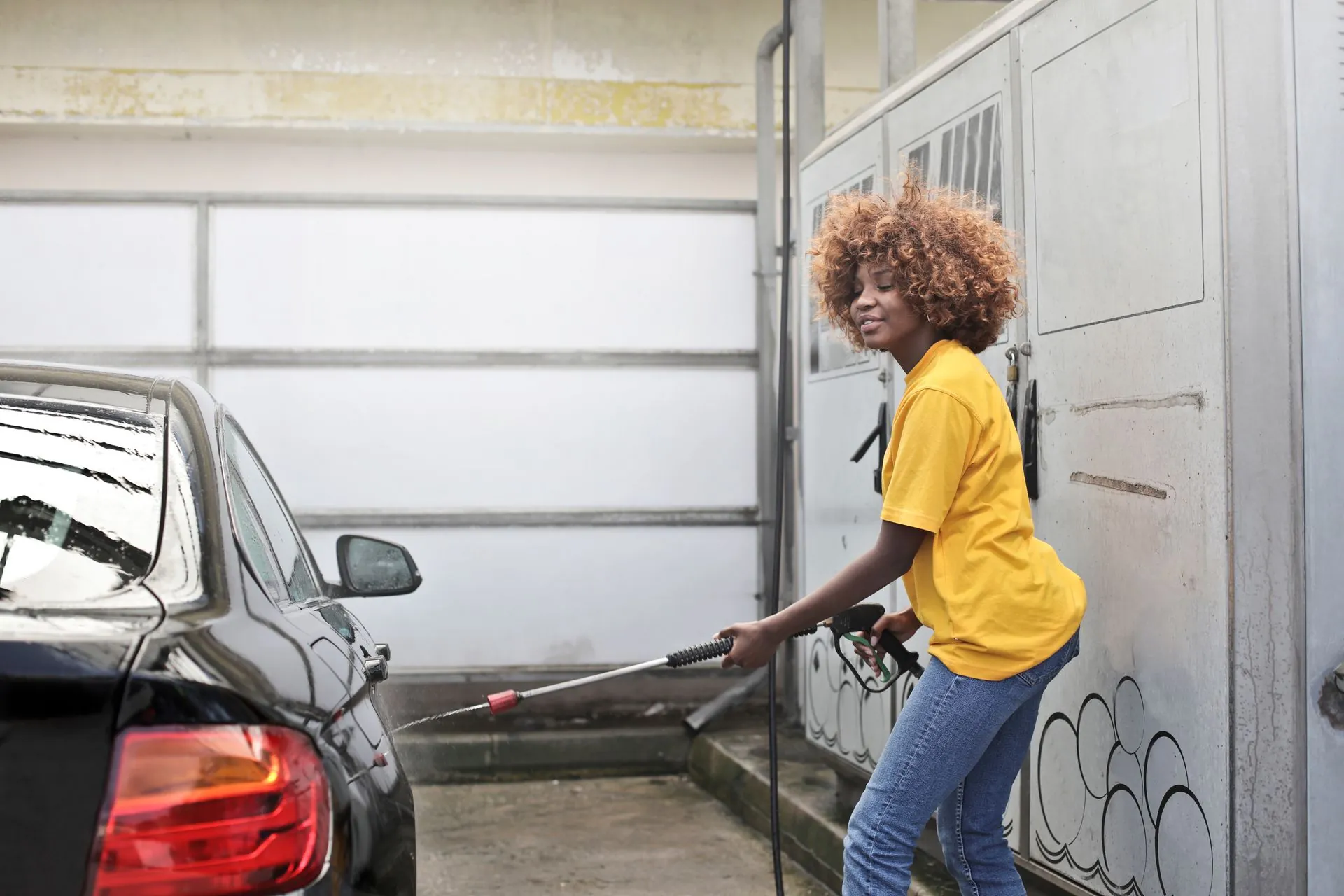
Stand next to somebody washing a car with a hose and count the seconds the water runs while nobody touches the car. It is usually most of them. The hose lies on the driveway through the soaping, through the wheel arches, through the phone call. That, and not the washing itself, is where the litres go.
Three numbers settle most of this argument.
The three numbers
| Method | Flow rate | Drawing water when |
|---|---|---|
| Pressure lance | 6 to 8 litres a minute | only while the trigger is held |
| Open hose | 15 to 20 litres a minute | continuously, once it is open |
| Automatic tunnel | 100 to 150 litres a vehicle | per car, start to finish |
The third column decides the argument, and it is the one most comparisons leave out.
The ten minute comparison, worked honestly
Take ten minutes of washing and put each method through it.
Open hose, ten minutes. The tap is open for all ten, because that is how a hose actually gets used. At 15 to 20 litres a minute, that is 150 to 200 litres.
Pressure lance, ten minutes. Ten minutes of washing is not ten minutes of water. The trigger is open for the rinse passes and shut while somebody works a panel with a mitt. Assume the trigger is genuinely open for four of the ten minutes: at 6 to 8 litres a minute, that is 24 to 32 litres.
Now stress test that assumption. Suppose the operator is heavy handed and holds the trigger for the full ten minutes without once letting go. That is 60 to 80 litres, and it is still under half of what the hose moved in the same ten minutes. The conclusion survives its own worst case, which is the only reason it is worth stating.
Automatic tunnel. A tunnel does not care about your ten minutes. It puts 100 to 150 litres through each vehicle and a car is out the other end in a few minutes. Against a ten minute hose wash it uses less. Against a lance it uses several times more.
What is measured and what is estimated
Worth separating, because the two get blurred.
- Equipment figures: the 6 to 8, the 15 to 20 and the 100 to 150 per vehicle are published rates for the equipment, not readings we took.
- Our assumption: that a lance trigger is open for roughly four minutes of a ten minute wash. That is a working estimate, nothing more. Your figure will move with the car, the dirt and the person holding the lance.
- Not a number at all: how long you personally wash for. Ten minutes is a convenient slice, not a standard.
Measure your own tap in two minutes
Put a bucket of known volume under the tap, open it as far as you would for a wash, and time the fill. Divide litres by minutes.
A 20 litre bucket that fills in 75 seconds took 1.25 minutes. 20 divided by 1.25 is 16 litres a minute. That is your figure, for your building, at that hour. Line pressure moves through the day, so a morning reading and a night one can differ.
Why a bucket is not automatically the greenest option
Two twenty litre buckets is forty litres. Nothing in the table beats it, and nobody should talk you out of that habit.
But least water and best outcome are not the same question, for three reasons.
- The grit goes back on the car. One bucket and one sponge means the dirt that came off the bonnet is now in the water, and the next pass carries it to the door. The fine scratches that show as a haze in direct sun are dragged grit. A machine polish to remove them costs far more water, and far more money, than the wash ever saved.
- A bucket does not change the source. Filled from the treated municipal tap it is treated municipal water, which is exactly the water Hyderabad’s prohibition is about. A bucket cuts the volume, not the category.
- The count drifts. Forty litres holds only if you stop at two buckets. A pre-rinse bucket, a soap bucket, a rinse bucket and a top up is eighty, and people rarely count past the first two.
A bucket wash done properly, with a genuine pre-rinse and two separate buckets, is a low water wash that does not cost you paint. A bucket wash done the way most are done is a low water wash you pay for later.
Where Hyderabad comes into it
HMWSSB prohibits washing vehicles with treated drinking water, in the same list as watering lawns, filling pools and hosing streets. The penalties in force run from Rs 20 to Rs 1,000, plus Rs 100 for each day the use continues, and in March 2025 a resident of Journalist Colony in Jubilee Hills was fined Rs 1,000. An increase of five to ten times has been proposed, but a proposal is not law and should not be quoted as one. The detail is in what the water rules say about washing your car.
The arithmetic connects to it directly. A ten minute open hose is 150 to 200 litres of treated drinking water spent on a use that is explicitly prohibited, in a neighbourhood where that has already drawn a fine.
The figure we are not going to give you
We are not going to print a litres per car number for this bay. It is in Jubilee Hills, it has not opened, and nobody has yet stood in it with a meter on the line. Any figure published today would be a guess dressed as a measurement, and you would have no way to tell which it was.
What we will state is method, because method is a commitment rather than a result: a pre-rinse before anything touches the paint, a foam blanket, a two bucket contact wash, and blown drying instead of a towel dragged over dry panels. When there is a measured figure, it will appear on the water page together with how it was taken.
Do this one thing
Put a bucket under your hose and run it for thirty seconds. Double what you collect. That is your litres a minute, measured rather than assumed, and every calculation on this page is now yours to run with your own number.
Written by The Car Wash Company, a single wash and detailing bay in Jubilee Hills, Hyderabad. We have not opened yet, so these notes are method and local context rather than a record of work done. If something here is wrong, tell us at[email protected]and we will correct it.